
JOURNAL · 21/04/2026
A Successful TVC Commercial Project
Behind the scenes of a TVC shoot at CINEFY Studio Da Nang: what happens in pre-production, on shoot day and in post, plus the role each crew member plays.

What a TVC shoot day at CINEFY actually looks like
A TVC shoot day in the studio runs through four stages: rigging lights and dressing the set, prepping talent, shooting the shot list, then checking and backing up the files. The first stage eats the most time, not the camera work. In this article, CINEFY takes you behind the scenes of a real TVC commercial production at CINEFY Studio

Pre-production: before shoot day
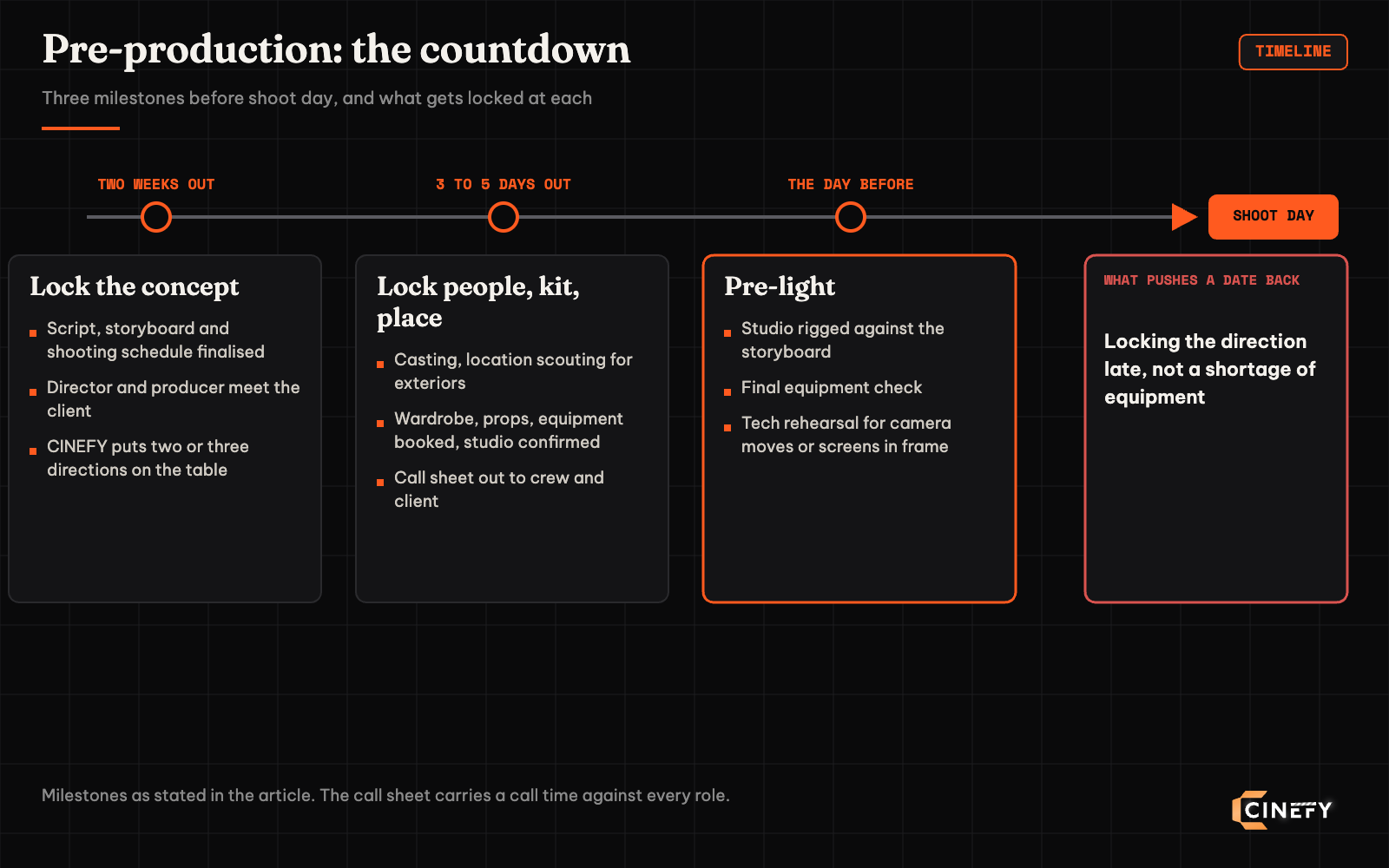
Two weeks out
Script, storyboard and shooting schedule are finalised. The director and producer meet the client to lock the concept; at this point CINEFY puts two or three creative directions on the table rather than a single one. Locking the direction late is what pushes a shoot date back, not a shortage of equipment.
Three to five days out
Casting actors or talent, scouting locations if the script has exteriors, sorting wardrobe and props, booking equipment and confirming the studio. The call sheet goes out to both crew and client at this stage, with a call time against every role.
The day before
Pre-light: the lighting team rigs the studio against the storyboard the night before. Final equipment check, plus a technical rehearsal if a shot involves camera movement or a screen playing inside frame.
Shoot day: who does what, and in what order
Six roles carry a shoot day, and knowing who owns which decision is what keeps the set from stalling.
| Role | What they own |
|---|---|
| Director | Performance, framing, the overall look of the piece |
| Producer | Timeline, budget, the line to the client |
| DOP | Camera angles, lens choice, how the image is built |
| Gaffer | Rigging and adjusting the lights to the DOP brief |
| Sound engineer | Recording and monitoring audio live on set |
| Art director | Set dressing, props, holding the visual concept together |
, from the first brief meeting all the way to final delivery.
Setup & Technical Check
The technical crew arrives early to set up lighting, camera, and audio. Every light is tested, color calibrated, and focus checked. Everything must be perfect before talent arrives.
Makeup & Wardrobe
Talent moves into the makeup room. The stylist preps wardrobe according to the concept. The director does a final storyboard review with the team.

Principal Photography
Shooting follows the shot list: wide shots, close-ups, insert shots, B-roll. Every scene is shot with multiple takes for maximum options. The director monitors on a large screen and gives real-time notes.
Wrap & Backup
Strike the set, back up all footage to two separate drives. The DIT (Digital Imaging Technician) verifies every file is safe. Never leave the studio before the backup is complete!
Post-production: from footage to final cut
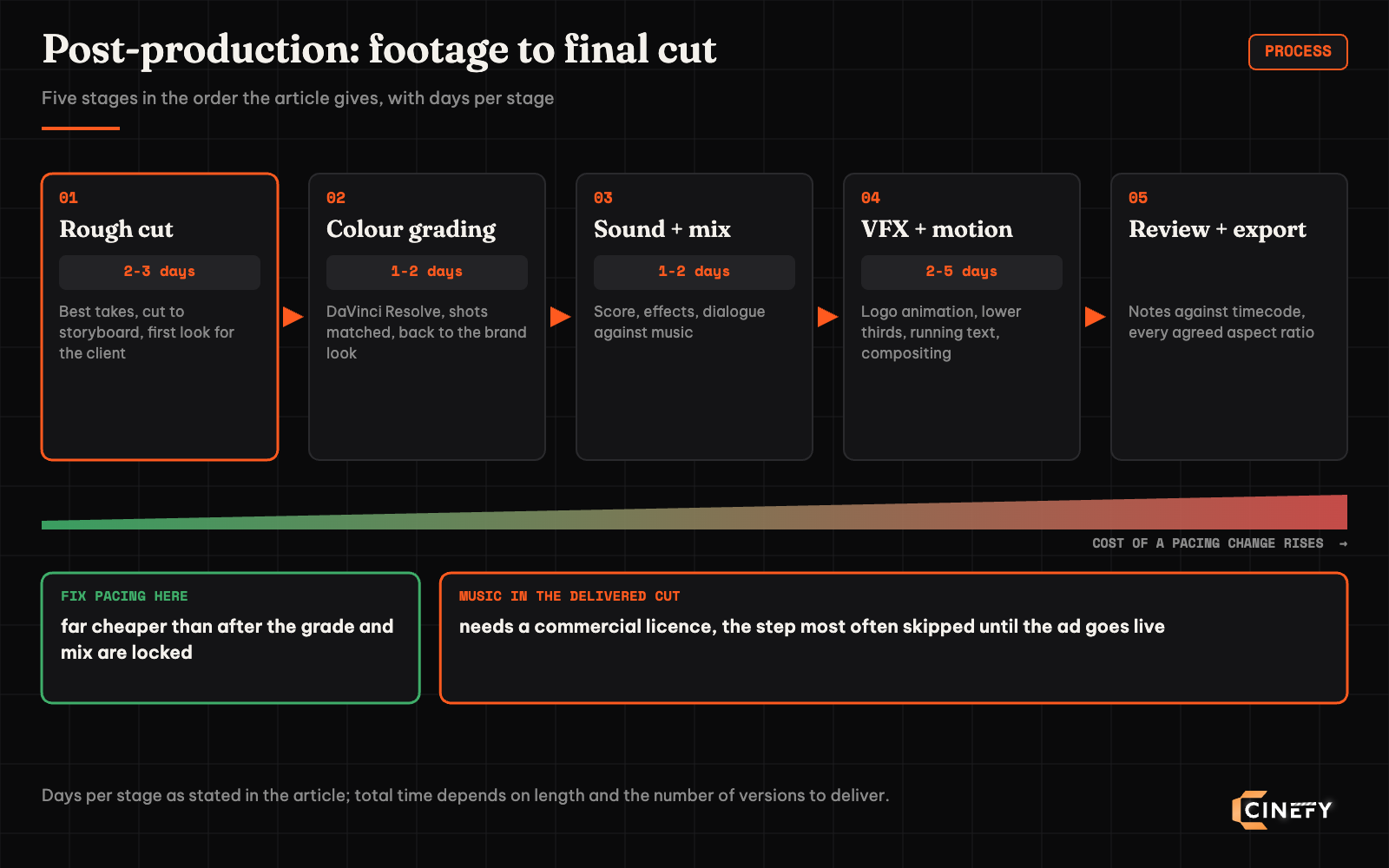
Rough cut (2-3 days)
The editor picks the best takes and cuts to the storyboard; the first rough cut goes to the client before anything else is done to it. Fixing pacing at the rough stage is far cheaper than fixing it after the grade and the mix are locked.
Colour grading (1-2 days)
The colourist balances the image in DaVinci Resolve, matches shots recorded hours apart and brings the look back to the brand identity the client already uses.
Sound design and mix (1-2 days)
Score, sound effects and the balance between dialogue and music. Voice-over is recorded separately in a treated booth. Music in the delivered cut has to carry a commercial licence, which is the step most often skipped until the ad actually goes live.
VFX and motion graphics (2-5 days)
Logo animation, lower thirds, running text, compositing. This follows the brand kit the client already uses rather than inventing new type for one TVC.
Client review and final export: a review cut goes out, notes come back against timecode, and the final files are exported in every aspect ratio agreed in the contract.
Results and key takeaways
Two things decide whether a shoot day runs on schedule, and both of them happen before anyone rolls camera: the storyboard is signed off before the shoot date, and the lights are already rigged from the night before. Miss either one and the lost time always lands on the last block of the day, exactly when the talent is most tired and the daylight outside has changed.
The third lesson sits in a corner nobody talks about: the backup. Footage is copied to two separate drives on set before anyone leaves the studio, because a card that fails after wrap is the one fault with no fix other than shooting the whole thing again.
What a studio shoot day usually gets booked with
Across the 20 studio bookings CINEFY logged between 22 Aug and 21 Sep 2026, 4 added a lighting technician, 2 added a smoke machine, 1 flagged a cloth green screen for a full body shot and 1 rented extra gear on top of the studio package. That list says something a rate card never does: the hours that disappear on a shoot day go into lighting and set, not into the camera.
Reading the equipment rental log for the same window, 22 August to 21 September 2026 (16 orders), the same shape shows up outside the studio too: lighting was the group that left the store most often at 4 orders, and the RS3 Pro gimbal went out twice, both times paired with a DJI wireless mic kit. A shoot day tends to break on light and on sound, rarely on the camera body.
| Add-on | Bookings out of 20 | Why it shows up |
|---|---|---|
| Lighting technician | 4 | Rigging and balancing lights is the biggest time sink of the first hour, and one of the four booked the technician for that first hour only |
| Smoke machine | 2 | Makes light beams readable in frame, common on product work and backlit setups |
| Cloth green screen flagged ahead | 1 | The booking specified a full body shot, so the screen has to be rigged at the right height before call time |
| Extra gear beyond the studio package | 1 | Small crews usually top up a couple of items instead of hauling a whole kit across town |
Figures come from the CINEFY studio booking calendar for 22 Aug to 21 Sep 2026. We counted bookings and add-ons only, with no client details.
Where a studio shoot day actually slips
These four stages are how a CINEFY crew runs a TVC shoot day in the studio, with the exact point where each stage tends to overrun. There is no fixed clock because every script is different, but the order almost never changes.
| Stage | What has to be done before moving on | Where it slips |
|---|---|---|
| First hour | Rig lights to the DOP plan, dress the set, test the camera and test sound | With nobody owning the lighting, the whole first hour goes into moving stands, which is why one booking hired a technician for that hour alone |
| Before the first take | Makeup, wardrobe, one test take and a listen back | Talent arrives at the same time as the crew, so prep eats into the shooting block |
| Main shooting block | Shoot the shot list and mark usable takes on the spot | Without a shot list you end up with too much footage and still miss the cutaway you need |
| Last half hour | Check the files, copy to two separate drives, strike the set | Backups get pushed to the end and then skipped because the room time is gone |
If only one line from that table survives, make it the last one: until the files sit on two drives, the shoot is not finished, however complete the shot list looks.
Choosing a TVC crew: seven criteria and how to check them
A shoot day that runs smoothly is the result of things settled well before it. The seven lines below come straight out of the process above, each with a way to check it before signing. The whole workflow sits inside CINEFY’s commercial video production in Da Nang service.
| Criterion | Why it decides the shoot day | How to check it before signing |
|---|---|---|
| There is a backup plan for the gear | The replacement is already held for your date, so swapping or adding an item mid-shoot does not cost half a day | Ask for a gear list that names each item, which items are held for your shoot day, and how soon a replacement can be on set |
| Studio and sets built on site | Shooting indoors does not depend on Da Nang weather; heat or rain, the call time holds | Ask about floor area, a ceiling grid for lights, three-phase power, a makeup room and a meeting room |
| A standing crew rather than one assembled per job | People used to working together shorten the lighting rig, the longest block of the day | Ask for a call sheet naming every role that will be present |
| A quote broken down by line item | You can see where the money goes, so you cut the right thing when the budget moves | Ask for shoot days, equipment and post quoted separately, with a validity date |
| Licensed music | An ad pulled over a music claim is the advertiser’s problem, not the editor’s | Ask which music library and which licence, and have it written into the contract |
| Delivery in every aspect ratio you need | One shoot covers both vertical and horizontal channels with no reshoot | Write 16:9, 9:16 and 1:1 into the delivery schedule |
| Bilingual paperwork and crew | It matters the moment the client or director does not speak Vietnamese | Ask to see a sample bilingual script or call sheet |
Frequently Asked Questions
How long does a TVC shoot at the studio take?
A simple 15 to 30 second TVC is usually shot in one day, 8 to 10 hours. A complex one needs two or three shoot days. Counting one to two weeks of pre-production and one to two weeks of post, a full project normally lands in the 2 to 4 week range.
How many people are on a TVC crew?
A basic crew is 5 to 8 people: director, DOP, gaffer, sound engineer and assistants. A full crew runs 10 to 15 once an art director, stylist and makeup artist are added.
Does CINEFY handle post-production?
Yes. Editing, colour grading, sound design, VFX and motion graphics are all handled in house, and delivery includes at least two rounds of revisions against the client notes.
Can the client attend the shoot?
Yes, and CINEFY encourages it. Client and agency sit at the monitor and sign off the important shots on the spot, because approving on set is cheaper than calling talent back.
How is the cost of a TVC shoot day worked out?
There is no fixed rate card for video production, because the number moves with shoot days, cameras, crew size and the amount of post. CINEFY takes the brief, breaks the quote down line by line and sends it back within 24 hours, so the client can see what changes if something is cut.
Studio or location for a TVC?
If the script does not need a real location, the studio wins on schedule: neither the dry season nor the rainy season in Da Nang moves an indoor call time. The studio booking log for 22 August to 21 September 2026 shows 4 of 20 sessions adding a lighting technician for the first hour, which says the hard part is rigging light, not rolling camera.

Related Articles
Ready to shoot your TVC in Da Nang?
CINEFY Studio: from concept to final cut, we handle everything
Let’s make something cinematic.
★★★★★ 5.0 · 183 Google reviews · replies within 24h