
JOURNAL · 18/09/2026
Does 32-bit float replace a separate recorder?
32-bit float removes clipping in the digital stage but cannot rescue a distorted mic or preamp. Three routes to 32-bit float, with real rental rates in Da Nang.

32-bit float is printed on almost every new audio product now, with an easy promise attached: no levels to set, no clipping to fear. On a real shoot it falls short in a few places that rarely get mentioned. This piece sets out what it does, what it does not do, and which route to it is cheapest from the CINEFY kit room in Da Nang.
In this article
- What 32-bit float actually does inside a recorder
- Why never clips is only half true
- Which cameras record 32-bit float in the body
- On a cinema camera, 32-bit float is an accessory, and it takes a slot
- Three routes to 32-bit float and real CINEFY rates
- When 24-bit is still the right call
- Frequently asked questions
What 32-bit float actually does inside a recorder
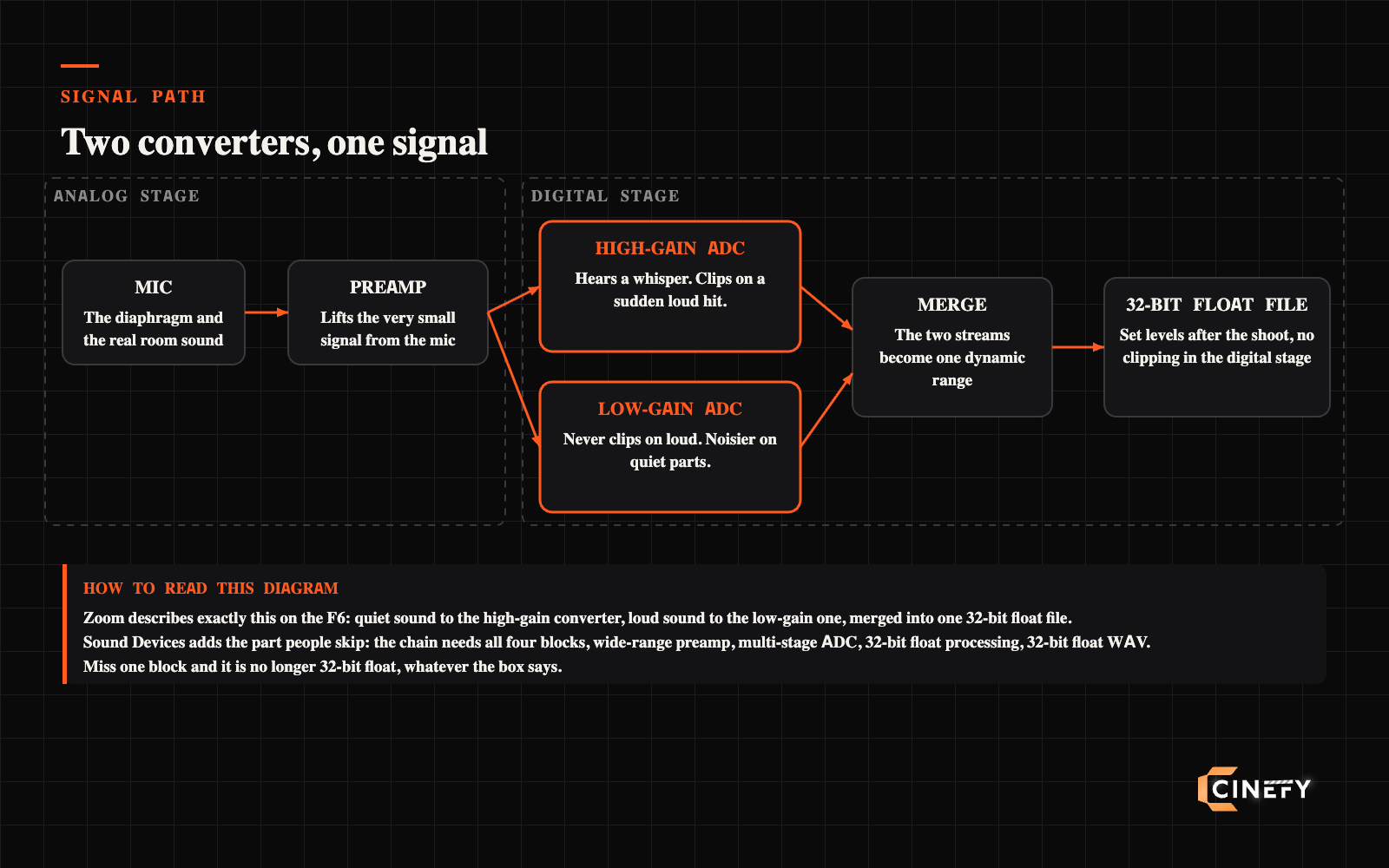
A 32-bit float recorder does not have one analog to digital converter, it has two. One runs at high gain and hears a whisper clearly. The other runs at low gain and does not clip on a sudden loud hit. The recorder runs both at once and merges them into a single file. Zoom describes exactly this mechanism for the F6, the first field recorder to pair dual converters with the 32-bit float format.
The rest sits in how the numbers are stored. A 24-bit file gives roughly 144 dB of range and anything above 0 dBFS is gone for good. A 32-bit float file stores values in something close to scientific notation, so the working range runs past 1,500 dB, far wider than the roughly 120 dB a human ear covers. Loudness stops being a place where data goes missing.
Sound Devices adds a line worth more than that number: the chain needs four blocks, a wide range preamp, a multi stage converter, 32-bit float processing and a 32-bit float WAV file. The company states plainly that 32-bit float data is required throughout the entire signal chain, and that missing one block breaks the system.
Why never clips is only half true
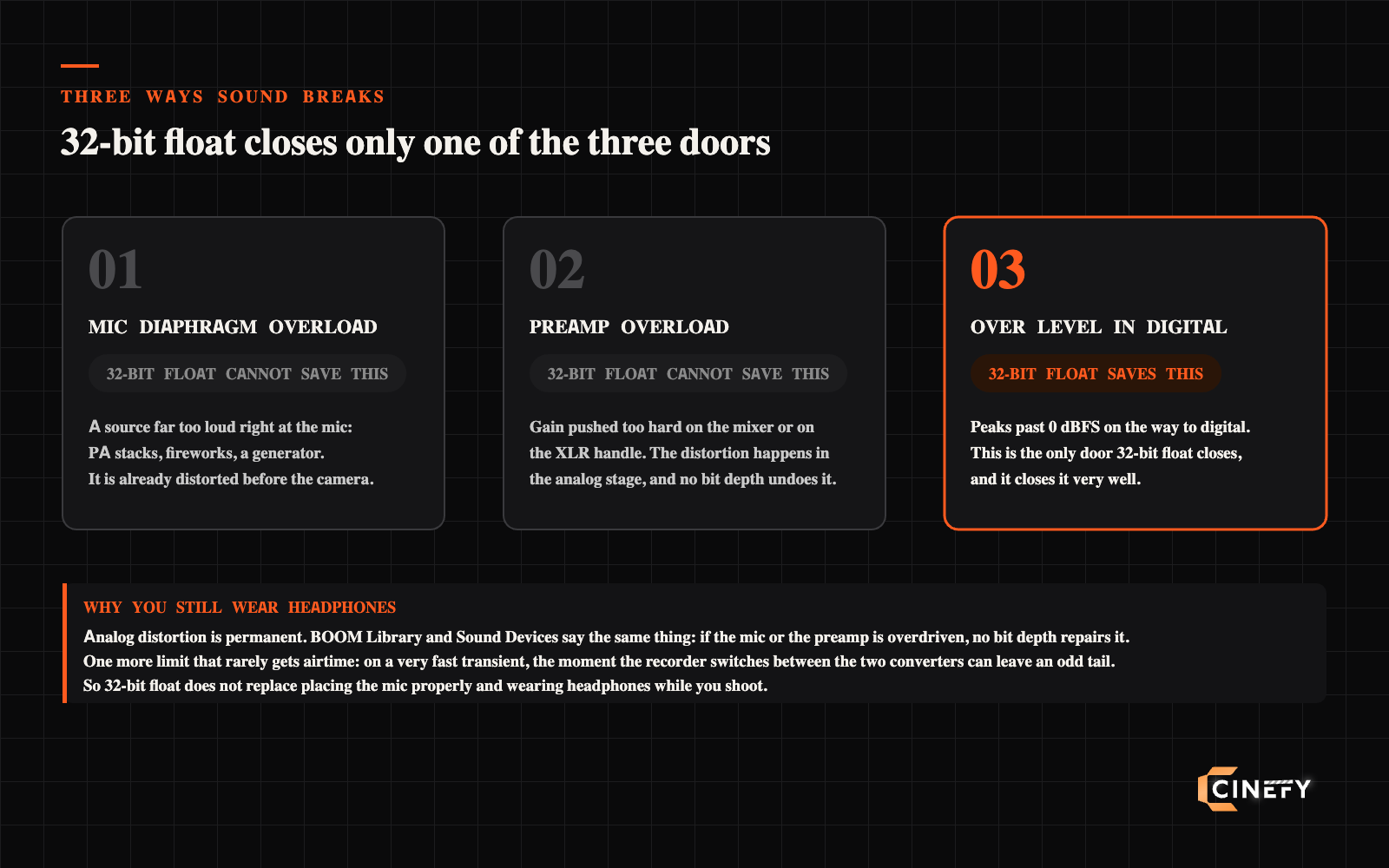
Sound breaks in three places and 32-bit float closes exactly one of them.
The first door is the mic diaphragm. A source far too loud right at the capsule, a PA stack or fireworks, overloads it. The signal is distorted before it ever reaches the camera, and no format undoes that.
The second door is the preamp. Gain pushed too hard on a mixer or on an XLR handle produces the same result, and it happens in the analog stage as well.
The third door is the moment the signal crosses into the digital stage. This is where 32-bit float works, and it works very well: peaks past 0 dBFS can be pulled back down after the shoot with nothing crunchy left behind.
BOOM Library, a field recording house, notes two further limits in its analysis of the format: on a very fast transient, the moment the recorder switches between the two converters can leave an odd tail, and 32-bit float files run about 33 percent larger than 24-bit, which shows up on a long multi mic day.
Which cameras record 32-bit float in the body
Short answer: very few, and almost always with a condition attached. The table below sums up the state of play as of September 2026.
| Device | 32-bit float in the body? | Condition |
|---|---|---|
| Camera bodies CINEFY rents out (Sony FX3, FX30, A7S III, RED Komodo X, Blackmagic Pyxis 6K) | No | The 32-bit float path has to run through a separate device |
| Panasonic Lumix GH7, S1II, S1IIE | Yes | Only with the separately sold XLR adaptor fitted |
| Sony FX5 | Yes, at 96 kHz | Only through the separately sold XLR handle, which wants the same MI shoe as the separate EVF |
| DJI Mic 2 wireless system | Yes, inside the transmitter | Records to the transmitter memory, independent of the camera |
| Zoom F6 and Zoom H6essential recorders | Yes | This is their main job |
Digital Camera World summed up the same picture in its explainer of 16 May 2025: the format is common on standalone recorders and wireless mics, but has not landed inside hybrid camera bodies as a default feature. A year and a half later that still holds.
On a cinema camera, 32-bit float is an accessory, and it takes a slot
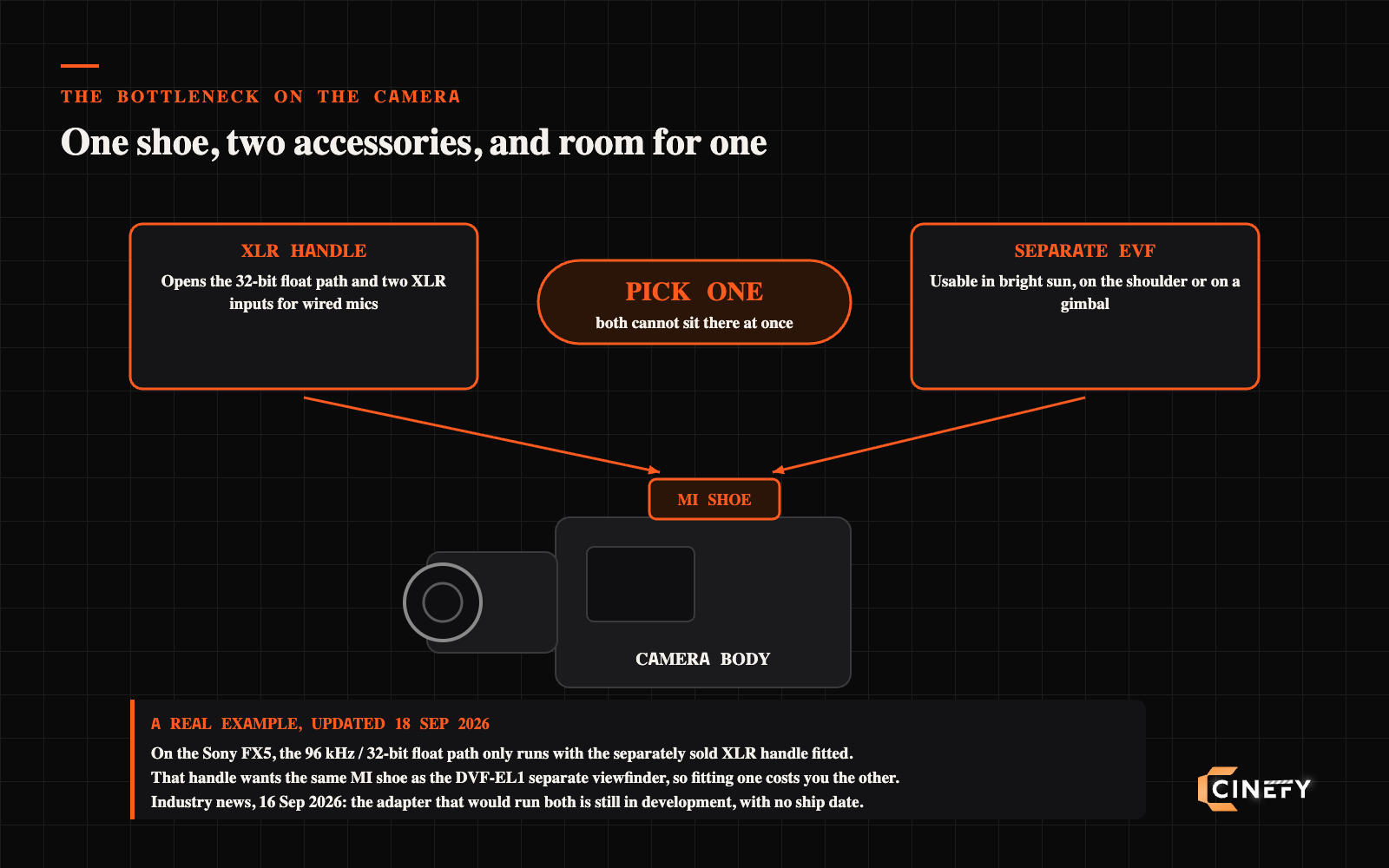
This part rarely makes the feature list. On the Sony FX5, the 96 kHz and 32-bit float path only runs with the separately sold XLR handle attached; a mic plugged straight into the body does not get it. So far this is only a question of money.
The awkward part sits elsewhere. That XLR handle shares one MI shoe with the DVF-EL1 separate viewfinder. Fit the handle and you lose the viewfinder; fit the viewfinder and you lose the XLR path. Industry reporting on 16 September 2026 confirmed that the adaptor which would run both is still in development, with no ship date.
For a working crew that is not trivial. A midday exterior in Da Nang more or less demands a viewfinder, because the rear screen washes out to the point where you cannot judge focus, while an indoor interview needs the XLR path for a boom and a lav. One camera, two needs, one mounting point.
So the useful question when renting is not whether a camera has 32-bit float, but what you have to give up to get it. A body by body comparison sits in Sony FX5 vs FX3 vs FX6.
Three routes to 32-bit float and real CINEFY rates
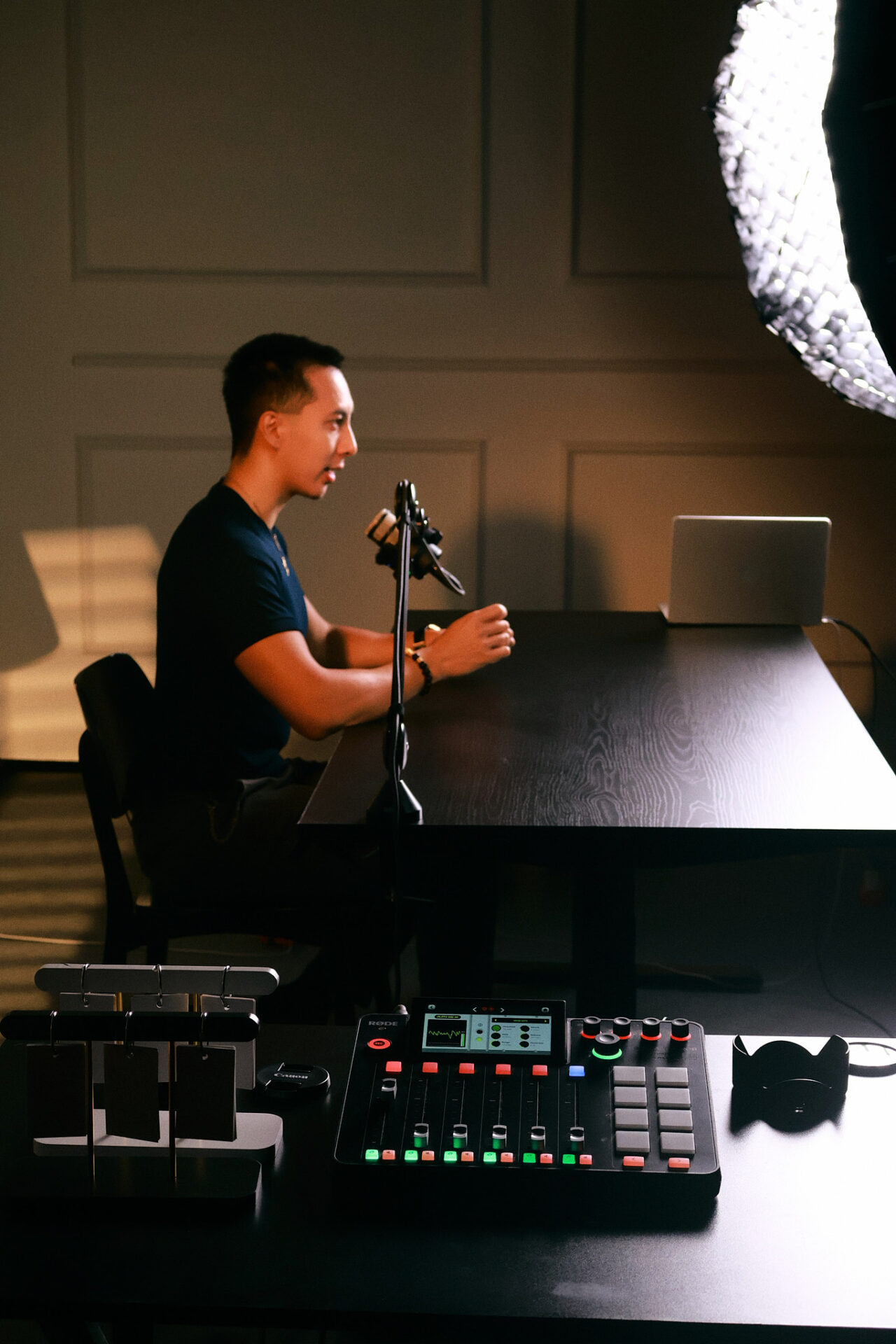
You do not need a different camera to get 32-bit float. There are three routes in the CINEFY kit room, and they differ by mic count and by whether someone is minding the sound. Rates below come from the rental price list updated on 24 August 2026, per day, VAT of 8 percent not included.
| Route | Device | Day rate | Suits |
|---|---|---|---|
| Recorded inside the mic transmitter | DJI Mic 2 | 350,000 VND | One or two speakers, plenty of movement, a one person crew |
| Compact standalone recorder | Zoom H6essential | 400,000 VND | Interviews on two to four mics with someone on headphones |
| Crew standalone recorder | Zoom F6 | 800,000 VND | Many mics, timecode needed, long shoot days |
| For comparison: 24-bit recorder | Zoom H4n Pro | 200,000 VND | Shoots with steady levels and someone watching them |
The mics come from the same list: a Sennheiser MKH 416 with boom pole and blimp at 1,000,000 VND a day, a Rode NTG5 at 450,000 VND, a Deity TC-1 timecode kit at 400,000 VND when sound has to line up across several cameras. Anything not held in the kit room is sourced to order with a few days notice, and we do not quote before the item is confirmed.
The full mic, recorder and intercom group sits on the audio and sound rental page; the other groups are on camera and film equipment rental in Da Nang.
When 24-bit is still the right call
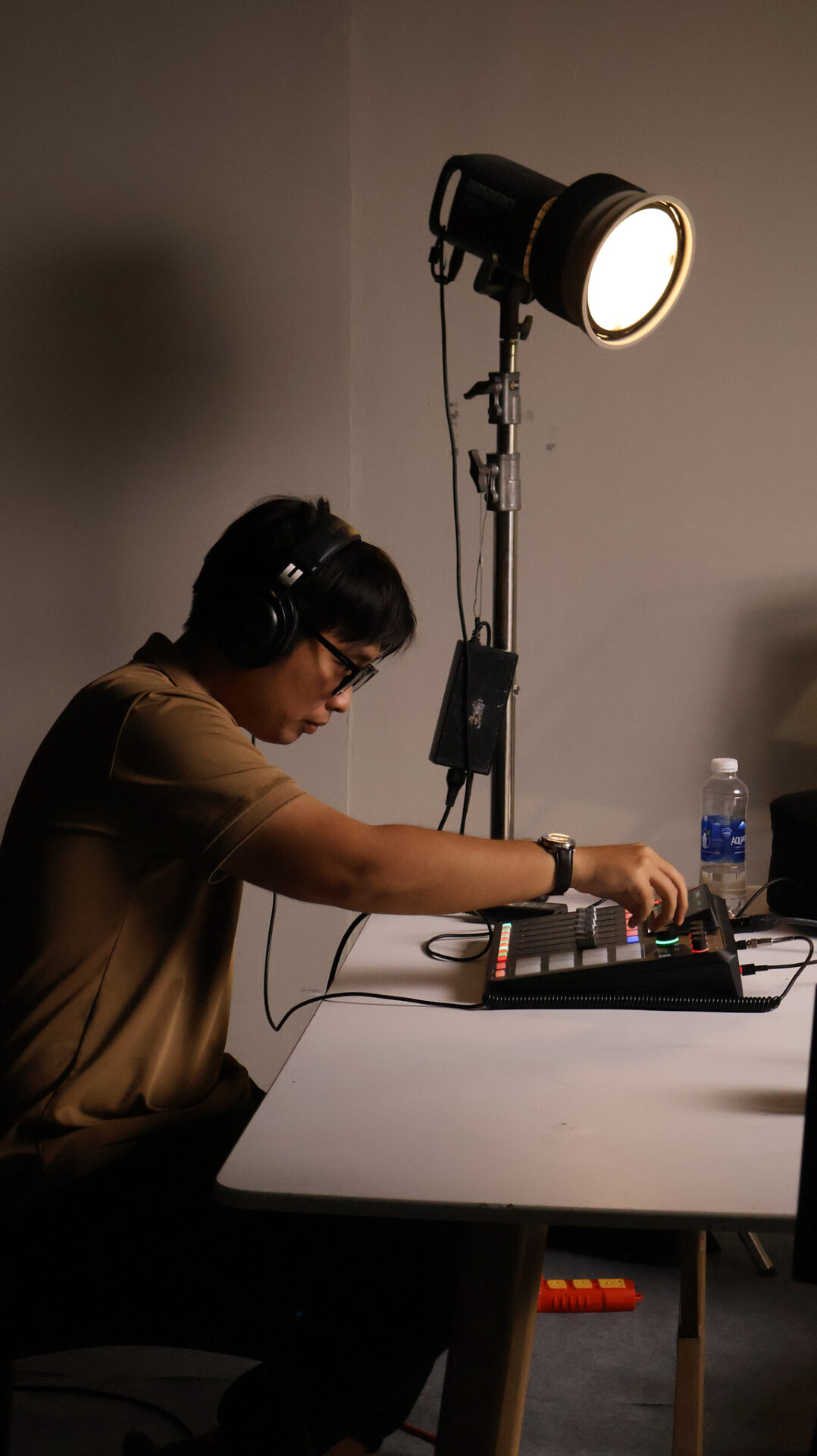
32-bit float buys safety for situations you cannot repeat. On a shoot you can repeat, that safety is not worth much.
| Situation | Pick | Why |
|---|---|---|
| Podcast or talking head in the studio | 24-bit, fixed mics, someone on headphones | Levels are steady, the room is controlled, a bad take is redone on the spot |
| Interview outdoors near the sea | 32-bit float plus a windshield | Unpredictable levels and a guest who will not sit down twice |
| A one time event | 32-bit float | No second take, and levels jump constantly |
| Shooting solo while also presenting | 32-bit float inside the mic transmitter | No free hand to ride gain mid take |
| Scripted commercial with many takes | 24-bit is enough | You can go again, and someone is watching levels |
1. Can this shot be repeated? If yes, 24-bit is enough.
2. Is anyone on headphones for the whole day? If yes, the risk is already covered.
3. Is the weak point of this shoot really gain, or is it wind, mic distance and background noise? If it is the latter, the money belongs in a windshield, a boom pole and a better mic position, not in a file format.
The groundwork on choosing and placing mics is in audio for video.
Frequently asked questions
Does 32-bit float make sound quality better?
No. It preserves precision when you change levels, it does not improve the microphone. How good the sound is still comes down to the mic, its placement and the room.
My camera has no 32-bit float, what do I do?
Record sound on a separate device running alongside and sync in the edit. A wireless set that records in the transmitter, or a small recorder, is enough.
What does a 32-bit float recorder cost to rent in Da Nang?
From the list dated 24 August 2026: Zoom H6essential at 400,000 VND a day, Zoom F6 at 800,000 VND a day, DJI Mic 2 at 350,000 VND a day. VAT of 8 percent is not included and multi day bookings are calculated differently.
Are 32-bit float files much larger?
About 33 percent larger than 24-bit, per BOOM Library. On one mic that is nothing; on six mics across a long day, bring extra cards and drives.
With 32-bit float, can I skip the headphones?
No. The format only closes the clipping door in the digital stage. A mic that slips, rubs on clothing, catches wind or dies on battery shows up only in the headphones.
Do studio podcasts need 32-bit float?
Usually not. The room is controlled, levels are steady and a bad take is redone immediately, so 24-bit with someone minding the sound is enough.
Where does the DJI Mic 2 record 32-bit float?
Straight into the memory inside the transmitter clipped to the speaker, independently of the signal sent to the camera. That is why it suits a one person shoot.
Does CINEFY carry Sound Devices recorders?
The kit room holds the Zoom line; other brands are sourced to order with a few days notice. Tell us the mic channel count and whether timecode is needed and the quote comes back faster.
Need a sound path you can trust on the next shoot?
Tell CINEFY how many people speak, indoors or outdoors, and whether anyone will be minding the sound. We put together the mic and recorder set that fits. Kit room at 179B Nguyen Cong Tru, An Hai, Son Tra, Da Nang, hotline 0779 771 234.
Let’s make something cinematic.
★★★★★ 5.0 · 183 Google reviews · replies within 24h