
JOURNAL · 21/06/2026
Corporate Video Production in Da Nang: Which Type to Make
Corporate video production in Da Nang: 6 video types by goal, the real CINEFY production process, and what drives the cost. Get a quote based on your brief.


CINEFY produces corporate video in Da Nang: company profile films, recruitment video, product video, internal and training video. The 360m² studio, the crew and the cinema kit are at 179B Nguyen Cong Tru, An Hai, Son Tra, Da Nang. Call 0779 771 234 for production and equipment rental, or 0965 408 519 for studio and podcast bookings. CINEFY has been running since 2022, with more than 200 video projects and more than 170 Google reviews at an average of 5.0.
Updated October 2026.
Corporate video production in Da Nang means making the official videos a company needs: company profile films, recruitment videos, product videos, internal content and training videos. Each type serves a different goal, so the first step is not picking the most expensive camera. It is picking the right type of video for your objective. Sounds obvious, yet most briefs that reach CINEFY open with exactly one line: “we’d like to make a video”, full stop. That is fine; it is exactly when we sit down and unpack it with you.
Every week at CINEFY we receive briefs from Da Nang businesses, and from companies in Hanoi, Ho Chi Minh City and overseas that want to film in central Vietnam. The first question is always the same: “What is this video for, and who will watch it?”. Answer those two and every decision about script, crew, gear and budget falls into place. This guide helps you choose well from the start. And if you plan to outsource the whole production, see how to evaluate a video production company in Da Nang before you commit.
1. What corporate video is · 2. 6 types of corporate video · 3. CINEFY production process · 4. What drives the cost · 5. One shoot, many cuts · 6. Why choose CINEFY
Need it produced? See CINEFY’s corporate video production in Da Nang: formats, a one-day shoot process and quote FAQs.
What is corporate video, and how is it different from a TVC?
Corporate video is the family of videos that build a company’s brand and credibility: telling its story, showing its capabilities, people, products or culture. Length usually runs from 1 to 5 minutes, and the video lives on a website, capability profile, conference screen, social channel or internal platform.
The easiest confusion is with a TVC. A TVC is a short 15 to 30 second advertisement built to run a campaign on television or digital platforms, fast paced and focused on a single sales message. Corporate video is broader and leans on story and trust. If you specifically need advertising, see our guide on commercial video production in Da Nang.
6 types of corporate video worth considering
An expensive camera will not tell your company’s story on its own. Choosing the right type of video is what decides the result. Here are the six most common formats, sorted by business goal.

| Video type | Main goal | Typical length | Best for |
|---|---|---|---|
| Company profile film | Branding and impressing partners | 2 to 4 minutes | Capability profile, website, conferences |
| Recruitment and culture video | Attract candidates, show the workplace | 1 to 2 minutes | Careers page, LinkedIn |
| Product or service video | Explain and drive sales | 30 to 90 seconds | Landing page, ads |
| Internal and training video | Internal comms, onboarding | 2 to 6 minutes | Training, internal events |
| Customer story (case study) | Build trust with real stories | 1 to 3 minutes | Sales, website |
| Event or factory recap | Capture scale and operations | 1 to 3 minutes | PR, social media |
The most popular choices for Da Nang businesses are the company profile film and the recruitment video. Both rely on interviews plus b-roll filmed at the office, factory or on location. The hardest part is never the gear. It is helping people who are not used to being on camera feel natural, and that is what the crew does every day.
The CINEFY production process
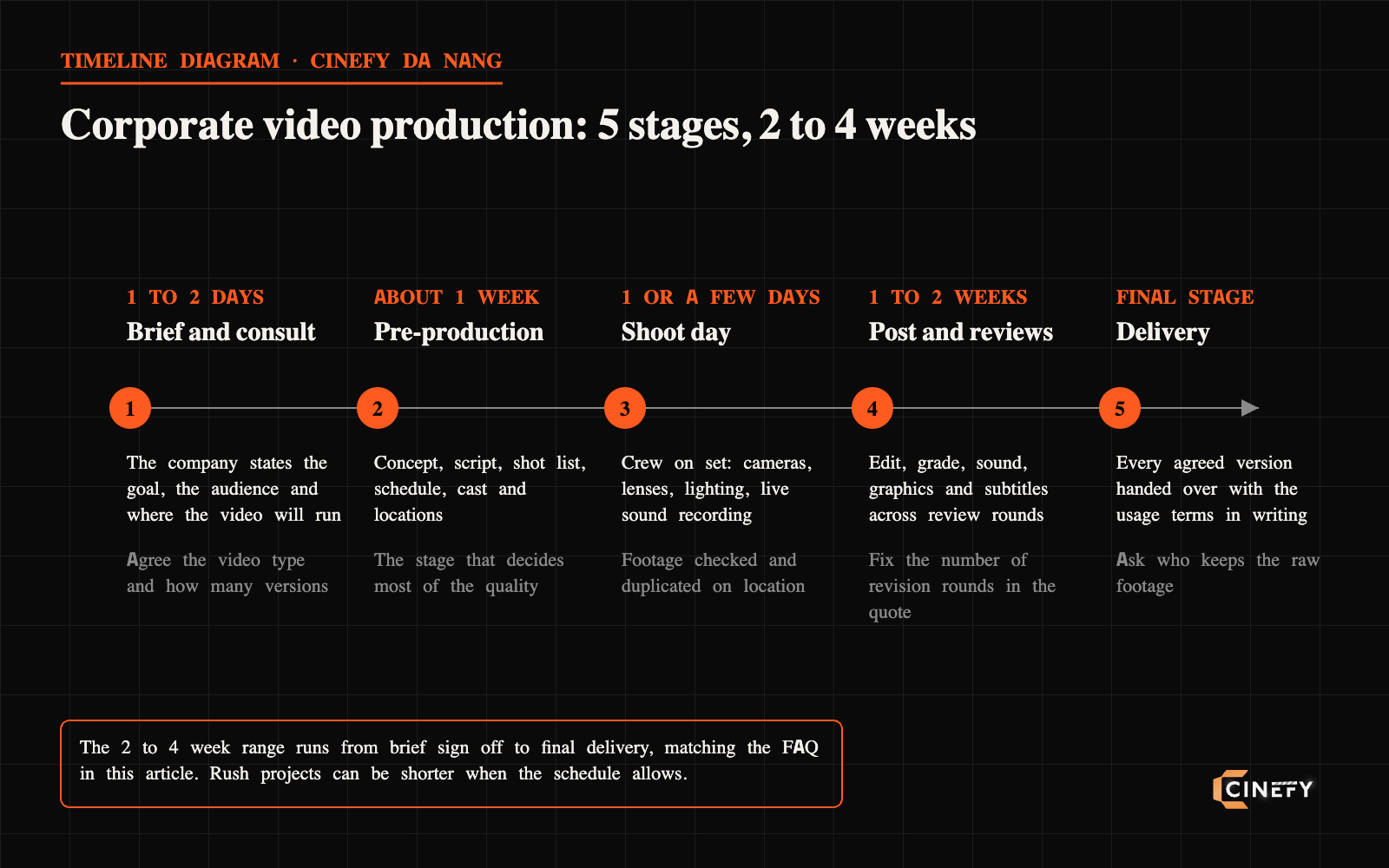
A strong corporate video moves through four clear stages. We keep the business involved at each one, so there are no surprises at the finish line.

1. Brief and consultation
We clarify the goal, the audience, the message and where the video will run. This is when we lock the right type of video.
2. Pre-production
We develop the concept, script, shot list, schedule, casting and locations. This stage decides roughly 80 percent of the final quality.
3. Production
The crew shoots with full cinema cameras, a complete set of lenses, lighting, live sound recording and movement gear. Depending on the brief, a shoot can use one camera or several. You handle the content, the equipment is CINEFY’s job. Who backs up the cards on set is a separate role, covered in DIT and data wrangler in Da Nang.
4. Post-production
Editing, color grading, sound, motion graphics and subtitles. We send drafts and take feedback in rounds so you can approve the cut before it goes public. On payment, video production runs on a 50 percent deposit to start pre-production, 30 percent on the shoot day and 20 percent after final delivery.
What does corporate video cost depend on?
There is no single number for every project, because two corporate videos are rarely alike. Instead of a rigid price list that misleads, CINEFY breaks down a quote per brief. The factors that move the budget the most are:

Shoot days. A tidy half-day shoot is very different from a multi-day, multi-location project.
Crew size. A simple interview needs fewer people than a film with a director, DOP, gaffer, sound and assistants.
Equipment. The number of cameras, lights, gimbals, drones and audio kit involved.
Locations. One office is not the same as covering several branches or a factory.
Post-production depth. Motion graphics, visual effects, bilingual subtitles and the number of revision rounds.
Internal numbers: which category actually moves most
Across the CINEFY equipment rental calendar for the window 5 September to 5 October 2026 there were 16 rental orders. The most requested group was lighting, 5 of those 16 orders, ahead of audio at 3 and stabilisation at 3; camera bodies accounted for only 2 orders in the same window.
That matches what the CINEFY crew meets on corporate sets: offices and workshops are usually short of light, rarely short of cameras. Low ceilings, fluorescent tubes mixed with window daylight, a different colour temperature in every room, and the interviewee seated with a glass wall behind them. So when a budget has to be trimmed, cutting the lighting package and the gaffer damages the picture more than dropping one grade of camera body.
One shoot, many video versions
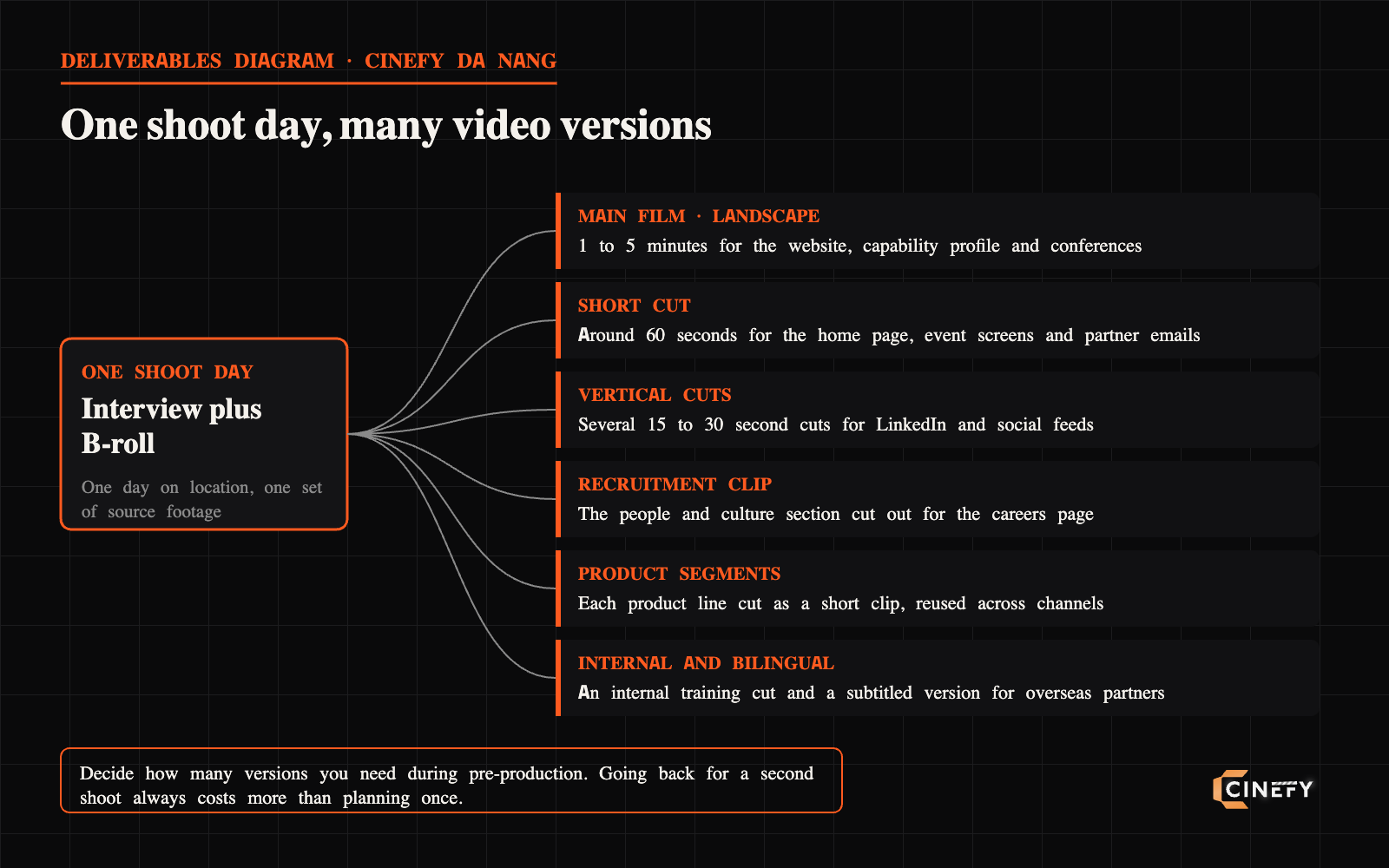
This is how businesses stretch a budget and still get plenty of content in 2026. A single interview-plus-b-roll shoot can produce a whole set of videos rather than just one file.

From the same shoot we can deliver the main profile film for the website, short vertical cuts for LinkedIn and social media, a separate recruitment clip, a few product segments and an internal version. Planning the full list of videos during pre-production is always cheaper than coming back to film again.
What to ask when a quote lands, and how to check it yourself
Most vendor selection guides stop at portfolio, process, team and the number at the bottom of the quote. The ten question list from Venture Videos (read 13 October 2026) has no line about usage rights or how many deliverables arrive, and the cost guide from Viva Media (read 13 October 2026) details every cost driver without saying who keeps the raw footage. Those are the three places a project runs into trouble after signature, so the table below turns them into questions with a way to verify the answer.
| What to ask when the quote lands | Why the question pays for itself | How to check it yourself |
|---|---|---|
| Exactly how many versions, in which formats, landscape or vertical? | One shoot day can produce a whole set; if it is not written down, the default is a single file. | Ask for the deliverables list inside the quote, before the shoot date is booked. |
| How many revision rounds are included, and what does the third one cost? | Extra revisions are the most common overrun on a video project. | Search the quote for the words revision round; if they are missing, ask in writing and keep the answer. |
| Who keeps the raw footage afterwards, and for how long? | Per the usage rights guide from Film Lifestyle (read 13 October 2026), raw footage and project files stay with the production company unless the contract says otherwise. | Ask directly, then have both access and retention period written into the contract. |
| Where can the video run, for how long, and does that include paid ads? | A usage licence has four dimensions: term, territory, channels and exclusivity. Paid media is normally priced separately. | List every channel in advance, trade show screens and internal channels included, then match the quote line by line. |
| Are the music and any extra footage commercially licensed? | Music rights are the most frequently skipped cost, and the gap only shows when a platform pulls the video. | Ask for the track name and the library it came from, and check the licence type before sign off. |
| Who is actually on set, and is anyone leading the interview? | A corporate film lives on what the speaker says, and that depends on who draws it out on the day. | Ask for each role on the shoot crew, then watch a film that same crew delivered. |
| What happens if it rains, or the production line cannot stop? | The Da Nang rainy season runs roughly from September to January, and exterior scenes are the first thing to move. | Ask for the contingency in writing: an indoor alternative and a reserve shoot day already held in the schedule. |
Why choose CINEFY in Da Nang?

CINEFY was founded in 2022, has delivered more than 200 projects and runs a 360m² studio in An Hai, Son Tra. Every quote names each item of gear (cameras, lenses, lighting, gimbals, audio), holds it for your shoot day and comes with a backup plan, so one faulty item mid-shoot does not leave the crew waiting. You can browse our cinema equipment library to see the capability.
A bilingual Vietnamese and English crew makes work easy for overseas companies and expats. When needed, we build sets inside the studio to control light and sound, avoiding the swings of Da Nang’s dry and rainy seasons. Learn more about our full video production services in Da Nang.
Send CINEFY a brief for advice on the right format and a line-by-line quote. Get a quote based on your brief.
Frequently asked questions
How long does corporate video production in Da Nang take?
Depending on scope, a project usually takes 2 to 4 weeks from a locked brief to final delivery, covering pre-production, one or more shoot days, and post-production with review rounds. Rush projects can be shorter if the schedule allows.
How long should a corporate video be?
It depends on the type and the channel. Company profile films are usually 2 to 4 minutes, recruitment videos 1 to 2 minutes, and social cuts should stay under 60 seconds. The point is to tell the story without losing the viewer halfway.
How is the cost of corporate video calculated?
CINEFY quotes per brief, based on shoot days, crew size, equipment, number of locations and post-production depth. After we receive the brief, you get a line-by-line breakdown. Payment follows a 50, 30 and 20 percent schedule.
Does CINEFY film for overseas companies and work bilingually?
Yes. Our bilingual Vietnamese and English crew has worked with many foreign directors, producers and expat businesses in Da Nang, including subtitles and cuts per language.
Do we need a script ready before filming?
Not necessarily. If you do not have one, CINEFY develops the concept and script with you during pre-production based on your business goals.
Who keeps the raw footage after the project ends?
Industry practice is that raw footage and project files stay with the production company unless the contract says otherwise, while the client receives the edited versions under the agreed usage scope. CINEFY writes the deliverables list and the usage scope into the quote itself; a company that also wants the raw footage should say so at brief stage so storage and handover can be planned in.
Can we shoot during the Da Nang rainy season?
Yes, because most corporate content is shot indoors: interviews, offices, production floors and the studio. For exterior scenes the CINEFY crew schedules around the wetter months from September to January, agrees an indoor alternative up front and holds a reserve shoot day in the calendar so nothing has to be renegotiated mid project.
Let’s make something cinematic.
★★★★★ 5.0 · 183 Google reviews · replies within 24h