
JOURNAL · 11/08/2026
DIT and Data Wrangler in Da Nang: Who Guards Files
A DIT protects how your footage looks. A data wrangler protects whether it still exists. Why multi-camera unscripted shoots in Da Nang lose material, what a verified copy means, and what data management costs.

A DIT protects how your footage looks. A data wrangler protects whether it still exists. On a multi-camera unscripted shoot those are two different jobs, and the second one is where productions in Vietnam most often get hurt. Netflix tells its own partners that a data manager or DIT is highly recommended purely because of the volume of material that has to be backed up.
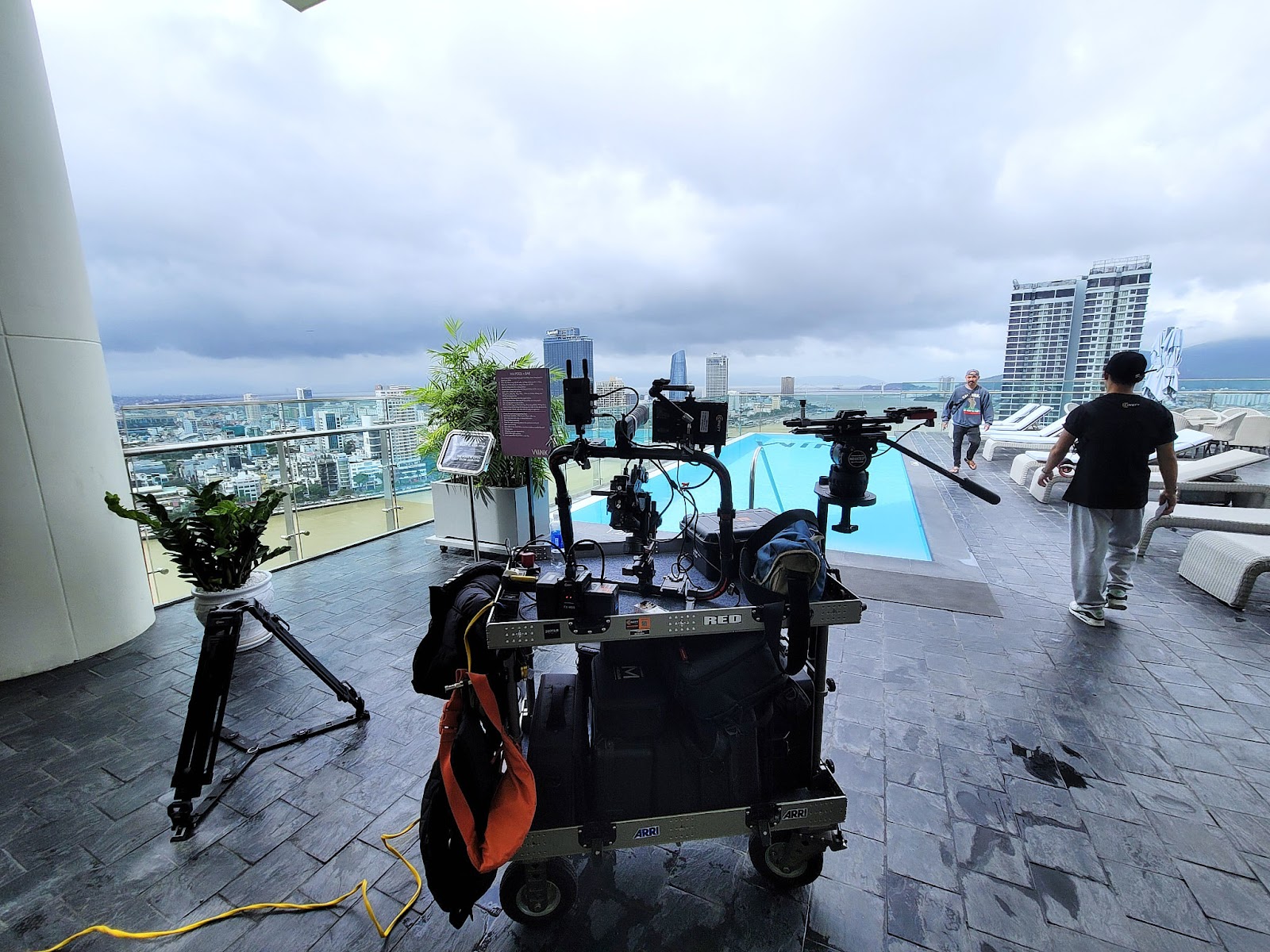
Scripted work is forgiving. If a take is lost you can usually shoot it again tomorrow. Unscripted work is not forgiving. The moment happened once, six cameras were rolling on it, and nobody is going to recreate it.
That asymmetry is the whole argument for putting a dedicated person on data, and it is the part most budgets try to cut first.
DIT and data wrangler are not the same job
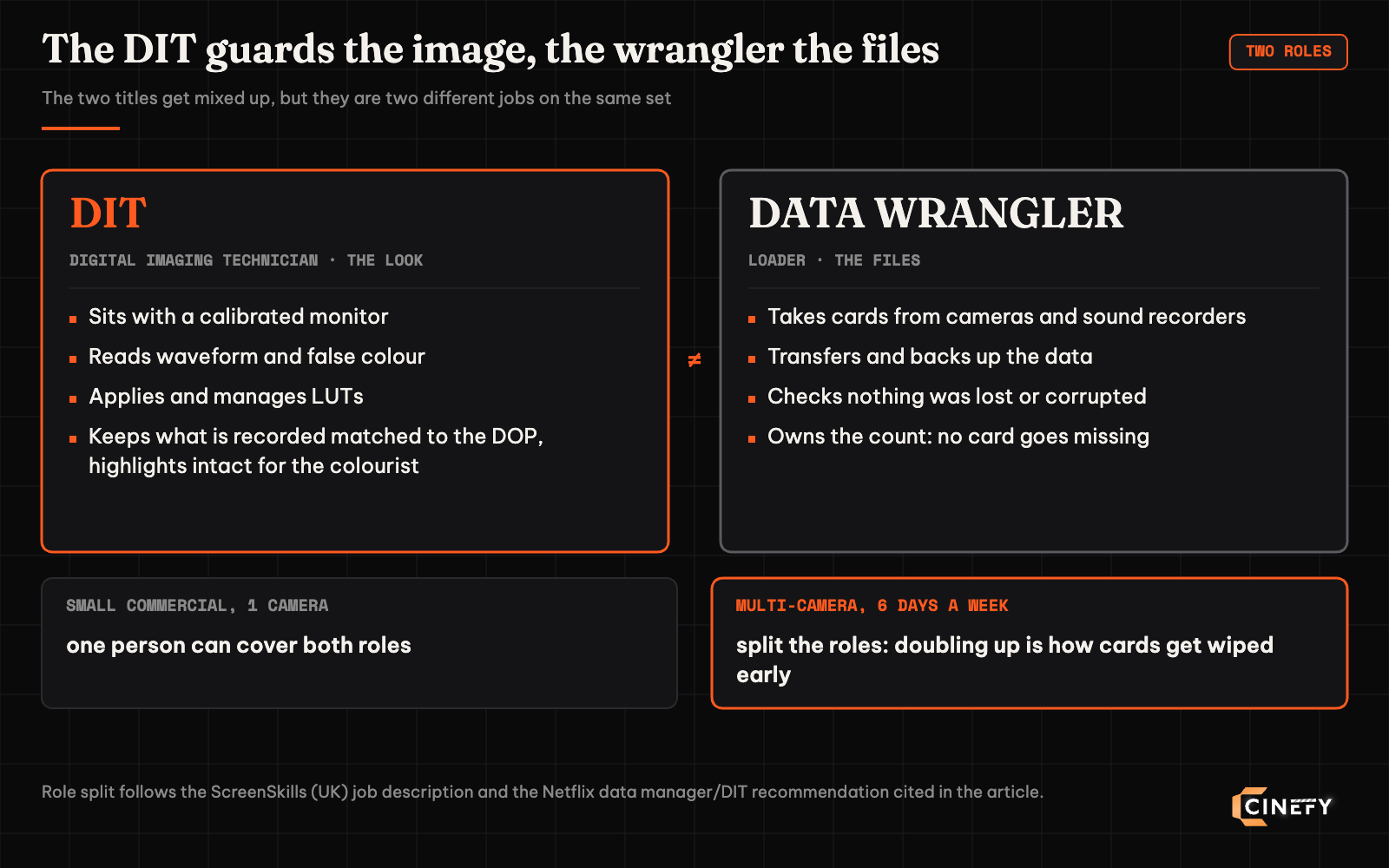
The two titles get used interchangeably in Vietnam, which causes real problems when a production books one person and expects the work of two.
The DIT, or digital imaging technician, owns the image. They sit with a calibrated monitor, read waveform and false colour, apply and manage LUTs, and keep what the camera records matched to what the director of photography intended. On a graded job they are the reason your footage still has highlight information when it reaches the colourist.
The data wrangler owns the files. In unscripted television the role is often called the loader. The UK industry body ScreenSkills describes the job plainly: take the cards from the cameras and sound recorders, transfer and back up the data, then check it to make sure nothing was lost or corrupted.
On a small commercial one person can wear both hats. On a multi-camera format running six days a week they cannot, and pretending otherwise is how cards get wiped early.
Why multi-camera unscripted is where footage actually goes missing
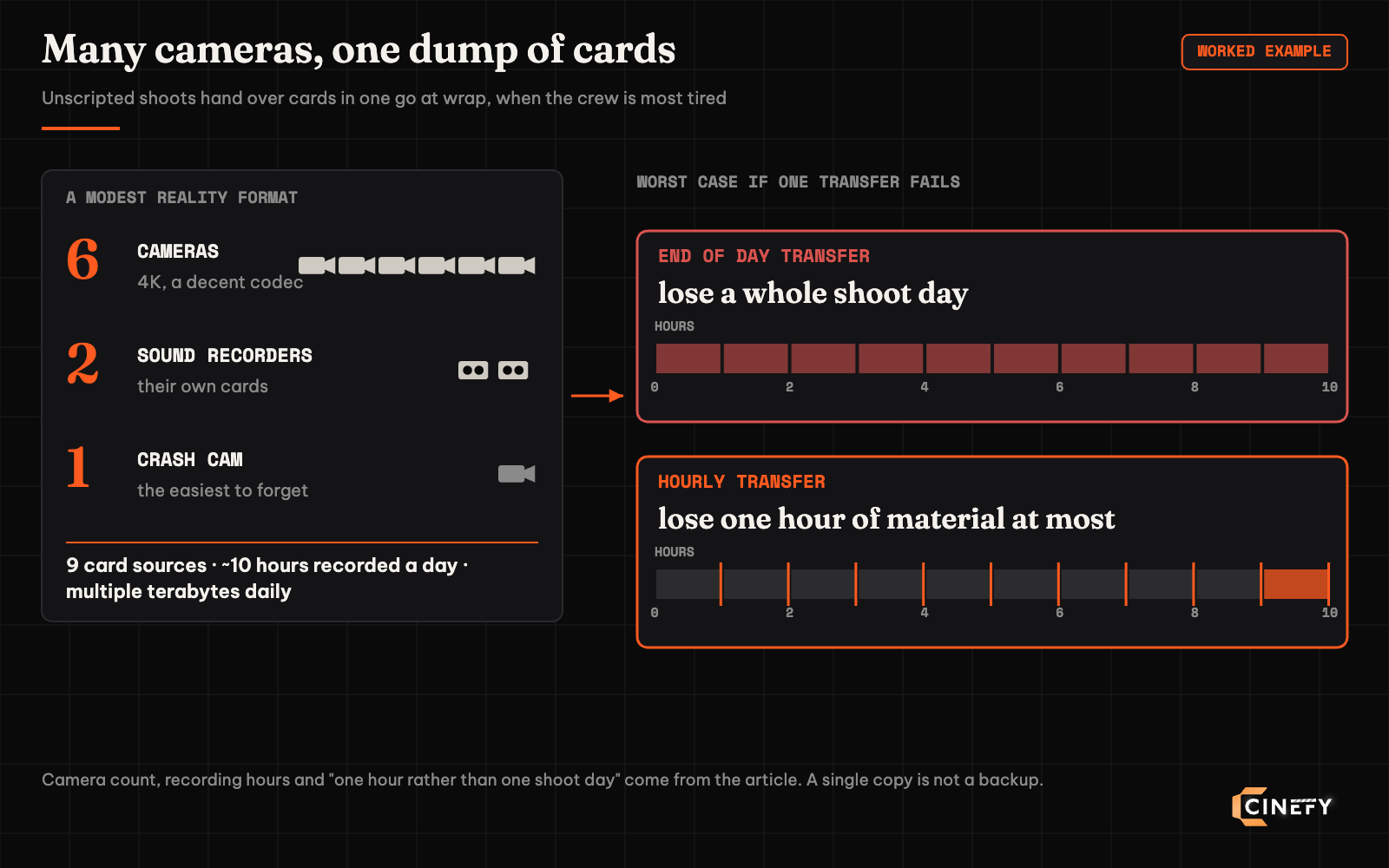
Do the arithmetic on a modest reality format. Six cameras, ten hours of recording a day, shooting 4K in a decent codec. You are looking at multiple terabytes landing every single day, arriving as dozens of cards from operators who are tired and want to go home.
Now add the failure modes that are specific to this format:
- Cards come back in a rush, all at once. Scripted work returns media in a steady trickle between setups. Unscripted returns it in a flood at wrap, which is exactly when attention is lowest.
- Cameras get reused before offload finishes. When a format needs to be back up and rolling in the morning, there is pressure to clear a card that has only been copied once. A single copy is not a backup.
- Nobody owns the count. With one camera it is obvious if a card is missing. With six cameras, two sound recorders and a crash cam, it is genuinely easy to lose track of one card and only discover it in post, weeks later.
- Manual offload does not scale. Industry coverage of modern multicam workflows is blunt about this: manually offloading drives from many cameras has become both inefficient and risky, and it is the source of slow turnaround and data loss.
The productions that solve this properly move to continuous or hourly transfer, so that the worst case is losing one hour of material rather than one shoot day. That is the standard worth designing towards even if your show cannot afford the full version of it.
What a verified copy actually means
This is the single most useful thing a producer can understand about data management, and it takes one paragraph.
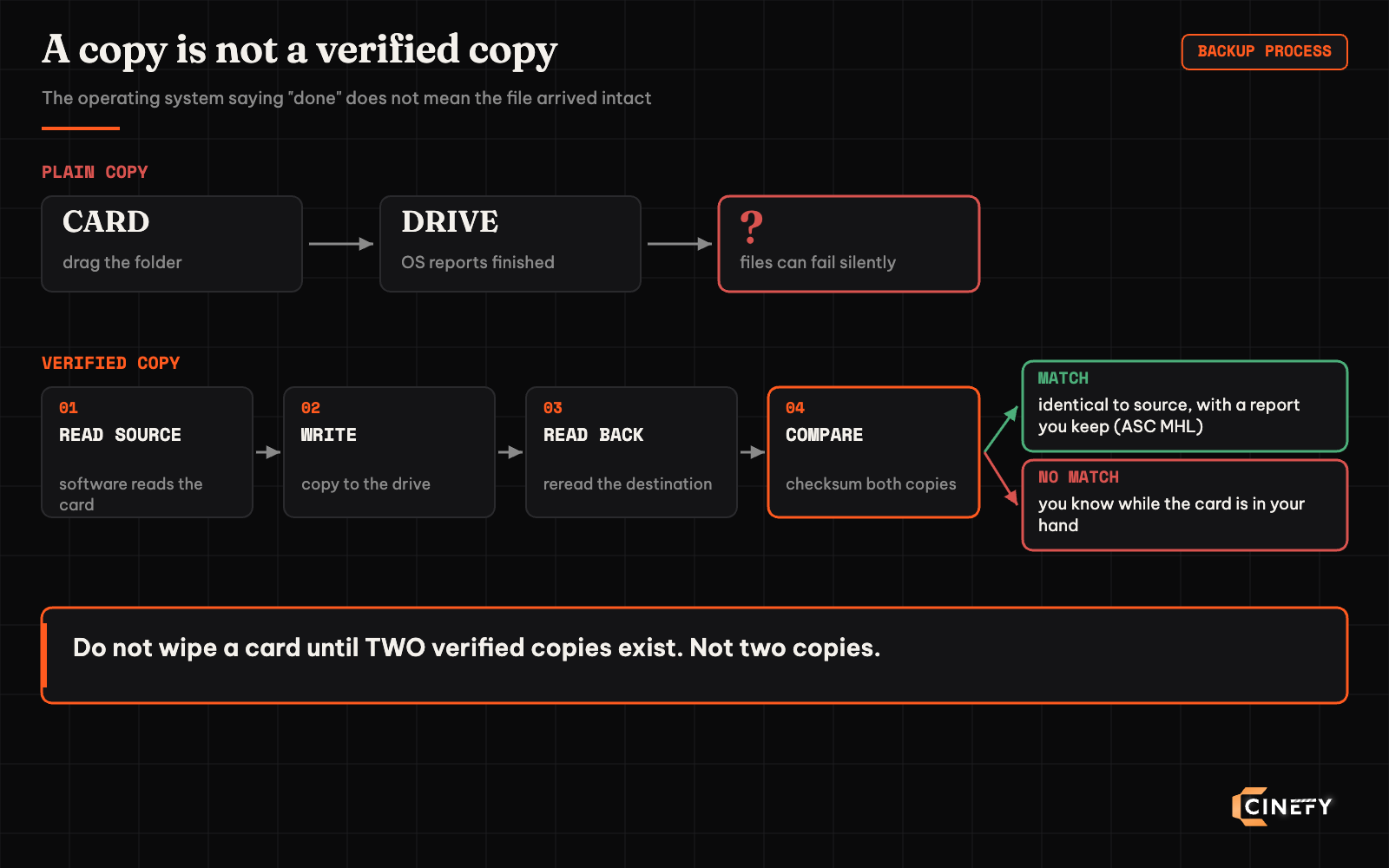
Dragging a folder from a card to a drive tells you the operating system finished moving the file. It does not tell you the file arrived intact. A copy can complete and still be silently corrupt.
A verified copy is different. The software reads the source, writes the destination, then reads the destination back and compares a mathematical fingerprint of both. If they match, the copy is provably identical. If they do not, you find out now, while the card is still in your hand, rather than in the edit suite. Netflix specifies ASC MHL as its preferred method for this, and the tools built for the job all produce a report you can keep.
Which leads to the rule that should be written on the wall of every unscripted shoot: never wipe a card until two verified copies exist. Not two copies. Two verified copies.
The 3-2-1 rule, and what central Vietnam does to it
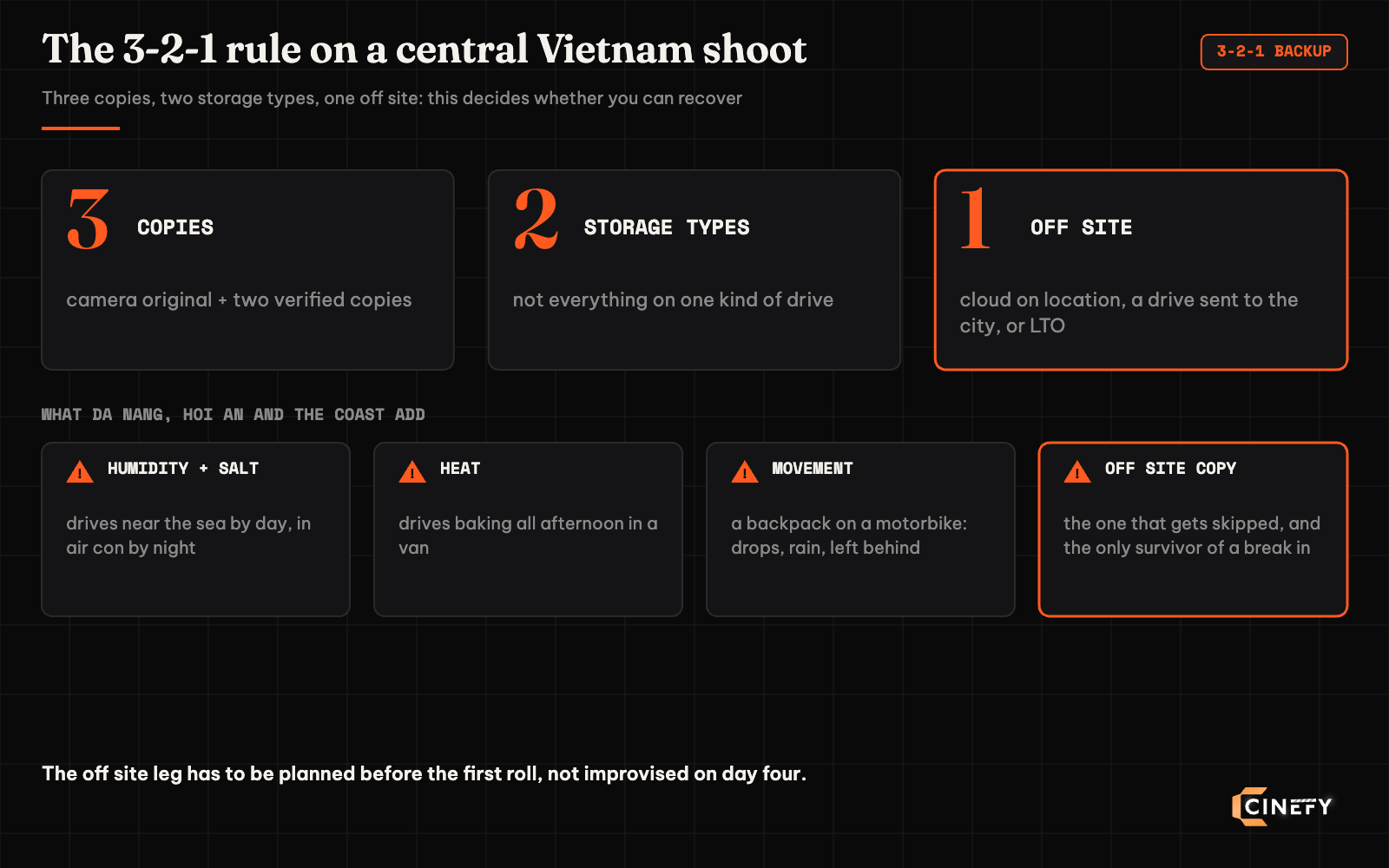
The standard media backup rule is three copies of your material, on two different types of storage, with one of them kept somewhere else. It is not theory, it is what recovery actually depends on.
Filming in Da Nang, Hoi An and the surrounding coast adds pressure the rule was designed for:
- Humidity and salt air. Drives spend the day near the sea and the night in an air conditioned room. Condensation is real and it is unkind to spinning disks.
- Heat. Drives that run hot in a van all afternoon fail at a higher rate than drives that live in an office.
- Everything travels. Unscripted formats move between locations constantly. A drive in a bag on a motorbike is a drive that can be dropped, soaked or left behind.
- Getting media home. The offsite copy is the one people skip because upload is slow and hand carrying feels easier. It is also the only copy that survives a vehicle break-in.
In practice this means the offsite leg needs to be planned before the shoot starts, not improvised on day four.
What it costs, and what moves the price
There is no useful single number, because the work scales with the shape of your production rather than with shoot days alone. The factors that actually move it:
- Camera count and codec. Six cameras in a high bitrate codec is a different job from two cameras in a compressed one.
- Turnaround. If the edit needs proxies the same night, that is a second workflow running alongside the backup.
- Whether you need image control too. A DIT with monitoring and LUT management is a different booking from a loader.
- Where the third copy lives. Cloud upload from location, a drive sent back to town, or an LTO archive each cost differently.
- Shoot length. A three day commercial and a six week format need different hardware entirely.
To place data management inside the wider crew budget: crew cost on a project depends on the number of shoot days, how many cameras roll at once and how many roles the set needs, so CINEFY quotes each line item within 24 hours of receiving a brief instead of giving one flat figure. Data management sits alongside those lines and is almost always cheaper than the cost of losing a day of material.
Frequently asked questions
Do I need a DIT or a data wrangler?
If your priority is that the footage matches the look you planned and survives grading, you want a DIT. If your priority is that nothing is ever lost across many cameras and many days, you want a data wrangler. Long form unscripted usually needs the second, and often both.
Can the assistant camera just handle it?
On a single camera commercial, often yes. On a multi-camera format, no. The assistant is busy during the shoot, and offload happens exactly when they are least available. This is how cards get cleared early.
Is copying to two hard drives enough?
It is better than one, but only if both copies are verified and the drives are not travelling in the same bag. Two unverified copies in one case is a single point of failure with extra steps.
What about shooting to internal media or SSDs?
The medium does not change the rule. Whatever the camera records to, it is still one copy until it has been offloaded and verified twice.
Do foreign productions bring their own DIT to Vietnam?
Large productions with big budgets often travel with a full package from Ho Chi Minh City or abroad. Mid sized shoots, long running unscripted formats and lean international crews usually do not, and hire locally instead.
Shooting multi-camera in Da Nang?
Tell us the format, the camera count and how many shoot days you have. We will map the data workflow with you before the first card is filled, and quote the crew and hardware it needs.
Read more
- How to hire a film crew in Da Nang: roles, rates and tips
- Video production services in Da Nang
- What a director of photography actually does
Sources: Netflix Partner Help Center (production assets data management, multicam best practices), ScreenSkills job profile for data wrangler in unscripted television, industry documentation of the 3-2-1 media backup rule, and published Da Nang crew rate guidance, all accessed August 2026.
Let’s make something cinematic.
★★★★★ 5.0 · 183 Google reviews · replies within 24h